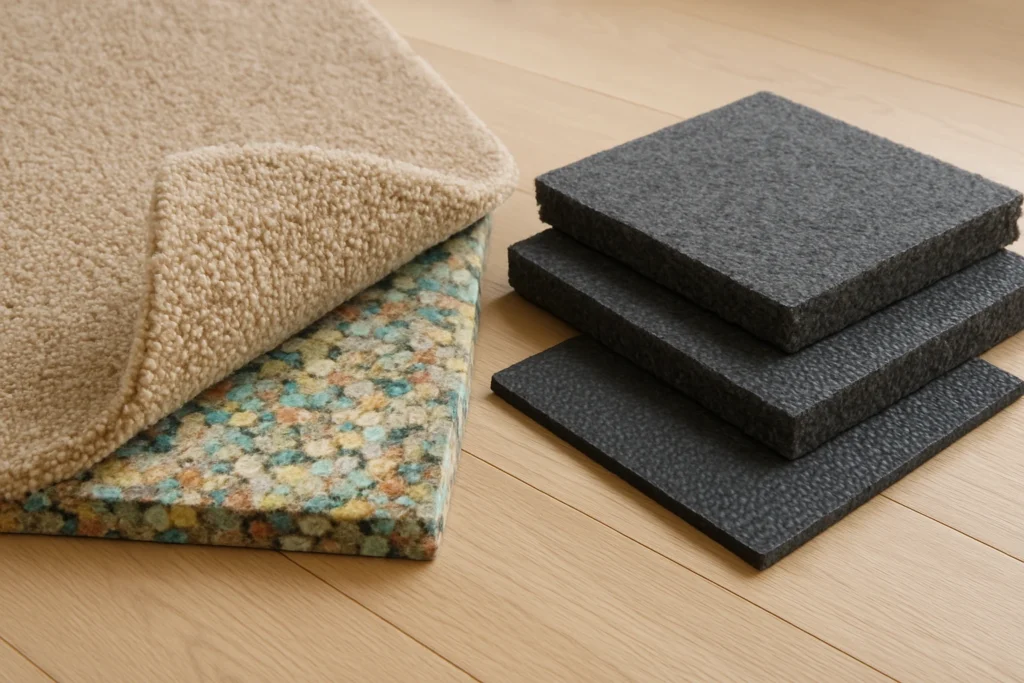
Carpet padding and carpet underlay usually mean the same thing: the cushion fitted between a carpet and the floor beneath it. Padding is the more common term in North America, while underlay is widely used in the UK and UAE. Choose based on the carpet maker’s requirements, material, thickness, and firmness, not the name on the pack.

Are Carpet Padding and Underlay Different Products?
Carpet padding and carpet underlay are not two separate types of product. Both names usually describe the same supporting layer, so two quotes may use different words for an identical product.
The confusion comes from the word underlay, which also applies to layers used beneath other floors. An underlay made for laminate is not a substitute for carpet cushion, even if both products come in rolls.
| Term | What It Usually Means | What to Check |
|---|---|---|
| Carpet padding or carpet pad | Cushion beneath fitted carpet, often in North American product descriptions | Material, thickness, density, and approved use |
| Carpet underlay | The same cushion, commonly named this way in the UK and UAE | The same product details as carpet padding |
| Rug pad or rug underlay | A separate layer beneath a loose rug | Grip, floor compatibility, and rug size |
| Laminate or wood underlay | A layer designed for a hard flooring system | Not suitable beneath carpet unless expressly approved |
| Attached carpet backing | Cushion or backing already bonded to the carpet | Whether a separate underlay is allowed |
When comparing products at Dubai Carpet Hub, ask for the specifications of the carpet underlay, rather than assuming padding is a cheaper or better option. A useful quote should name the product and state its thickness, material, and intended fitting method.
For example, a quote for an 8 mm rebond foam pad and another for an 8 mm rebond foam underlay may describe similar products. You can only compare the quotes fairly once the density, product grade, and fitting costs also match.
Which Underlay Material Suits Your Carpet?
Choose the underlay material to suit the carpet and how the room is used. A soft bedroom floor, a busy staircase, and an office chair area place very different demands on the cushion beneath them.

| Material | Where It Can Work Well | Main Trade-Off |
|---|---|---|
| Rebond foam, made from bonded foam pieces | Many domestic fitted carpets | Quality varies, so thickness alone tells you little |
| Polyurethane foam | Bedrooms and living spaces where comfort matters | Very soft grades may give too much under foot traffic |
| Rubber | Areas needing firm support, where the carpet maker permits it | Often costs more and can be heavy to handle |
| Felt or fiber | Certain woven carpets and systems needing a firmer base | Usually feels less springy than foam |
| Rubber and felt combination | Compatible carpets needing both support and some cushion | Must match the carpet and fitting method |
Material names are only a starting point. Two foam products can feel and perform very differently, and a rubber underlay is not automatically the right choice for every room.
Match Support to the Way the Room Is Used
For a bedroom, some extra softness may feel pleasant because foot traffic is usually light. For a busy living room carpet, firmer support often makes more sense because the cushion must spring back after repeated use.
With stair carpet, choose an underlay approved for both stairs and the carpet itself. A thick, soft cushion can let the carpet move too much around the stair edge, where secure fitting and support matter more than a deep, plush feel.
For office carpet, check that the underlay is suitable for rolling chairs and heavy use. A domestic cushion can allow too much movement beneath chair wheels, even when it feels firm under a person’s hand.
Check Special Carpet Types Before Adding Cushion
Some carpets need a specific base or no separate cushion at all. Carpet tiles normally need a tile-specific fitting system, and loose domestic underlay can affect their stability and joints.
Natural-fiber products such as sisal carpet may need a particular underlay and adhesive method. Outdoor carpet needs a system suited to moisture and drainage, rather than ordinary indoor foam.
For a large mosque carpet installation, choose the carpet and cushion together as one system. Comfort matters, but so do stable seams and even support across a wide floor.
How Thick and Firm Should Carpet Underlay Be?
The best carpet underlay is thick enough to provide comfort but firm enough to support the carpet without too much movement. The carpet maker’s limits come first, because a thicker cushion can be the wrong choice even when it feels more luxurious.

The Carpet and Rug Institute’s consumer guidance gives a maximum cushion thickness of 7/16 inch, about 11 mm, and a minimum density of 6 pounds per cubic foot for most residential carpets. It gives a lower maximum thickness of 3/8 inch, about 9.5 mm, for Berber and other low-profile carpets. These are general industry guidelines, not permission to ignore a carpet maker’s stricter limits.
Thickness, density, and firmness describe different things:
- Thickness is the depth of the cushion before it is compressed.
- Density is the weight of material within a set volume. Within the same material type, a higher figure often means more substance in the cushion.
- Firmness is how much the cushion gives under weight, which is not the same as density.
Do not compare foam and rubber by density alone, because they are different materials. Even within one material type, a density figure does not replace an approved-use rating or the full product details.
A common mistake is choosing underlay by squeezing a small sample between two fingers. That shows its initial softness, but not how well it supports a fitted carpet under repeated walking. Ask to stand on a carpet sample over the proposed cushion, but check the written specifications too.
Why Excess Cushion Movement Causes Trouble
Carpet needs support beneath its backing, not just softness beneath your feet. If the cushion compresses too far, the backing bends more with each step, which can put extra strain on seams and the carpet structure.
For a low-profile loop carpet, choose a firm, low-profile cushion approved for that product. For a deeper cut-pile carpet, a slightly thicker cushion may be allowed, but the maximum thickness still applies.
If you are choosing the carpet, cushion, and fitting method together, the guide to the best underlay for wall-to-wall carpets explains how these choices fit together.
Does Every Carpet Installation Need Separate Underlay?
No, separate underlay is not part of every carpet installation. The fitting method determines whether the carpet needs a loose cushion, a bonded cushion, or direct contact with the prepared floor.

| Fitting Method | How Underlay Is Used | Main Check |
|---|---|---|
| Stretch-fit | Carpet is stretched over a separate cushion and held by perimeter grippers | Cushion thickness, firmness, and secure fitting |
| Direct glue-down | Carpet is bonded to the prepared subfloor | Do not add loose cushion beneath it |
| Double-stick | Approved underlay is bonded to the floor, then carpet is bonded to the underlay | All products and adhesives must work together |
| Attached-cushion carpet | Cushion is already part of the carpet | Follow the maker’s rules on extra layers |
For wall-to-wall carpet, agree on the fitting method before buying the underlay. A product intended for stretch-fit work may not be suitable for a double-stick installation.
The floor beneath also needs attention. Underlay can soften the feel of a sound floor, but it cannot fix loose boards, moving joints, deep dips, or a rough concrete surface.
Before fitting, the installer should:
- Check that the subfloor is sound, clean, dry, and suitably level.
- Check the combined carpet and underlay height at doors, thresholds, and adjoining floors.
- Check the fitting instructions for which way up to lay the underlay and how to join it.
- Fit the cushion without overlapping edges or leaving gaps that could show through the carpet.
- Install the carpet using the approved method and tools.
Do not stack two underlay layers to make a carpet feel softer. Unless a manufacturer has approved that exact combination, extra layers can create movement and affect the fitting.
What About Concrete, Moisture, Sound, and Floor Heating?
Underlay can improve comfort and reduce some footstep noise, but it does not solve dampness or guarantee soundproofing. On concrete floors in Dubai, check the floor’s condition and any building requirements before choosing a cushion.
A concrete slab can contain moisture even when its surface looks dry, especially after construction or a leak. Ask for the moisture checks required by the carpet and adhesive makers. A foil face or spill-resistant top layer does not prove that the whole system can safely cover a damp slab.
Spill Protection Is Not Damp Protection
Some underlays have a surface designed to slow spilled liquid from reaching the floor beneath. That can help with a small spill, but liquid may still travel through seams or around the edges.
A spill-resistant cushion does not replace prompt cleaning, and it does not stop moisture rising from concrete. If a room smells musty or has a known leak, find and correct the cause before fitting carpet.
Acoustic Claims Need a Tested Floor Build-Up
Carpet and cushion can soften footsteps and reduce the sharp sound of objects hitting the floor. They do not necessarily stop voices, music, or other airborne sound passing between rooms.
For an apartment with sound insulation rules, ask for a test report that covers the same floor construction, not just a large decibel figure on a product label. The slab, ceiling, carpet, and cushion all affect the result.
Heated Floors Need a Compatible System
Where underfloor heating is fitted, both the carpet and underlay must be approved for use over it. Their combined thermal resistance, which means how much they slow heat flow, must stay within the heating supplier’s limit.
A thick cushion may feel warm underfoot while reducing the heat reaching the room. Check the combined rating instead of choosing underlay on thickness alone.
How Do You Compare Prices and Choose the Right Product?
Compare carpet padding and underlay prices using the same material, thickness, product grade, and fitting work. The name on the quote should not change the price, but the product details and installation work can.

For a rough Dubai budget, basic to mid-range domestic foam underlay may cost around AED 10 to AED 40 per square metre for supply only. Treat that as a starting point rather than a current quote, because supplier, grade, order size, and location affect the price. Specialist products and fitting can cost more.
Check the carpet underlay price guide for Dubai when setting a budget, then ask for a written quote for the exact product.
For a worked example, suppose an underlay is quoted at AED 25 per square metre. A 20-square-metre room would have a base material cost of AED 500 before any cutting allowance, delivery, fitting, floor preparation, or applicable VAT. This is an example calculation, not a product offer.
Room area is not always the same as the amount you need to order. Recesses, roll width, and the layout of cuts affect waste, so use a measured plan rather than adding a fixed percentage to every room. The guide on how to calculate carpet area can help with that first step.
Before accepting a quote, confirm:
- The carpet and underlay product names, not just “premium padding.”
- The underlay material, thickness, and density where relevant.
- The underlay’s approval for the carpet, room use, and fitting method.
- The inclusion or exclusion of removal, disposal, floor preparation, fitting, and VAT.
- Any carpet warranty conditions tied to cushion choice.
For most buyers, the carpet padding vs underlay question has a simple answer: they usually name the same layer. Choose a cushion that meets your carpet’s requirements and suits the floor beneath it, rather than the thickest or softest roll in the shop.
Frequently Asked Questions
Can I Reuse Old Underlay When Replacing My Carpet?
You can reuse old underlay only if it is sound, clean, dry, and approved for the new carpet. Check for flattened walking routes, crumbling edges, odors, and uneven firmness, since these can affect the new floor. Also check the new carpet’s warranty terms, which may require a new cushion.
Does Carpet Underlay Help with Allergies?
Carpet underlay is not an allergy treatment, and a hypoallergenic label does not guarantee fewer symptoms. Keeping the carpet clean and dry matters more than choosing between the words padding and underlay. If dust or odors are a concern during replacement, remove old materials carefully and clean the exposed floor before fitting.
Can I Put Carpet Underlay Beneath a Loose Rug?
Ordinary fitted-carpet underlay is usually not the best choice beneath a loose rug because it may not provide safe grip. Choose a rug pad made for the rug and the floor finish beneath it. Check compatibility with wood, vinyl, or stone, since some backing materials can mark or react with certain finishes.
How Long Should New Carpet Underlay Smell?
There is no single reliable time for new underlay odors to disappear, because the product, adhesive, room temperature, and ventilation all matter. Follow the supplier’s airing and occupancy advice, and ask for emissions information if you are sensitive to smells. A strong, persistent, or worsening odor should be reported rather than covered with fragrance.
Can I Replace Underlay Without Replacing the Carpet?
Replacing underlay while keeping the carpet is sometimes possible if the carpet can be lifted and refitted without damage. A fitter should first check its backing, seams, edges, and remaining stretch. Glued installations are much harder to separate, and an older carpet may not survive removal well enough to make the work worthwhile.