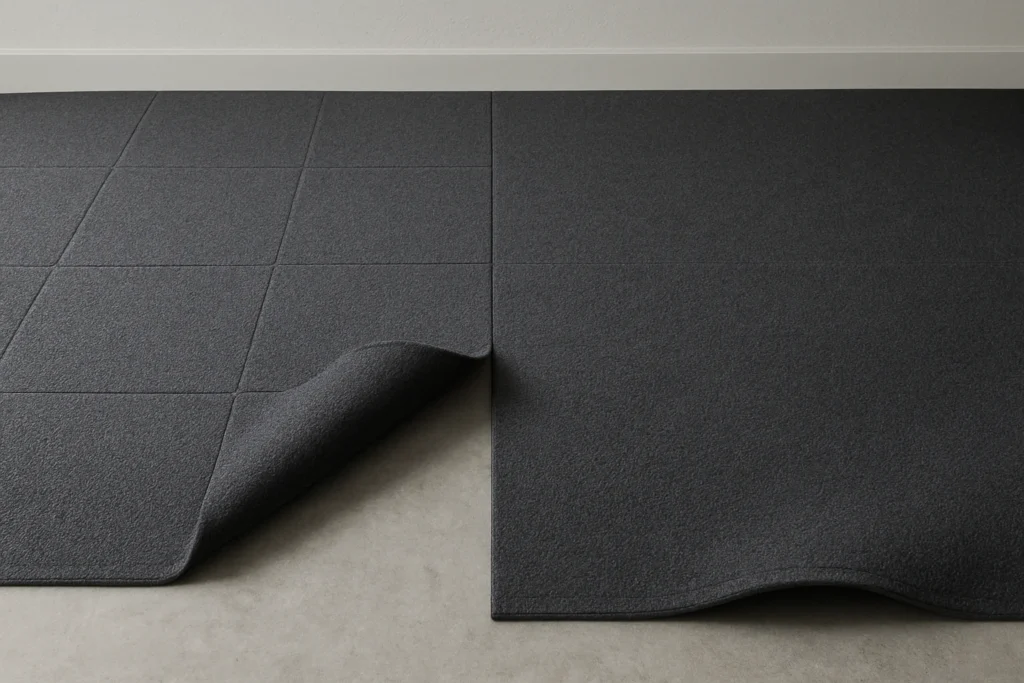
Carpet tiles are usually the better choice for busy offices and rooms where small areas may need replacing, while wall to wall carpet often suits bedrooms and living rooms where softness and a continuous look matter most. Neither is always cheaper or more durable, because carpet quality, backing, floor preparation and fitting method all affect the result. Compare the full fitted cost and likely repair needs, not just the price per square metre.

Carpet Tiles Vs Wall to Wall Carpet at a Glance
Carpet tiles are separate carpet squares or planks fitted side by side, while wall to wall carpet comes on a roll and is cut to fit the room. Both can cover an entire floor, so the real difference is separate pieces versus larger sheets, not how much floor they cover.
At Dubai Carpet Hub, you can compare carpet tiles and wall to wall carpet by their intended use rather than appearance alone. A soft bedroom sample and a firm office sample may look similar in colour but hold up very differently under furniture and foot traffic.
| Buying Factor | Carpet Tiles | Wall to Wall Carpet |
|---|---|---|
| Appearance | A grid, plank pattern or blended surface, depending on the design | A continuous look, though larger rooms may need joins |
| Feel Underfoot | Usually firm, with cushioned versions available | Often softer when paired with suitable underlay |
| Local Damage | Individual tiles can usually be replaced | Small patches are possible but may be easier to notice |
| Installation | Often fitted with approved tackifier, adhesive or connector tabs | Commonly stretched over underlay or glued down |
| Awkward Room Shapes | Small pieces can reduce cutting waste | Roll width and pattern matching can increase waste |
| Access Beneath the Floor | Useful over raised access floors when the system allows lifting | Less convenient where access is needed often |
| Cleaning | Vacuuming and product-approved spot or deep cleaning | Vacuuming and product-approved spot or deep cleaning |
| Best Starting Point | Busy offices, work areas and rooms with spill risks | Bedrooms, lounges and spaces where comfort comes first |
The main mistake is treating these as two grades of carpet. They are two formats, and either can be made from budget or high-quality materials. Compare products rated for the same use, rather than a premium tile against a basic roll carpet.
Which Costs Less in Dubai?
Wall to wall carpet can have a lower starting material price, but carpet tiles may cost less to repair over time. The cheaper fitted floor depends on room shape, carpet grade, waste, underlay and the work needed beneath it.
For early budgeting in Dubai, standard synthetic carpet tiles may cost roughly AED 35 to AED 110 per square metre for supply only, while synthetic wall to wall carpet may be around AED 30 to AED 130 per square metre. These are broad planning ranges, not quotes, and prices vary by supplier, product and location. Premium wool, specialist backing and heavy commercial products can cost more.
Basic fitting may add roughly AED 15 to AED 35 per square metre, but small-job minimum charges, underlay, adhesive, removal and floor repairs can change the total. Check whether VAT and delivery are included before comparing prices.
Compare Purchased Area, Not Just Room Area
Carpet is priced by the area you buy, which may be larger than the floor you cover. This matters most with roll carpet, because available roll widths may leave a long offcut that cannot be used elsewhere.
For example, imagine a simple room measuring 3.6 metres by 5 metres, with a floor area of 18 square metres. If a suitable carpet comes in a 4-metre roll, buying a 5-metre length means paying for 20 square metres before any extra fitting allowance. At an example price of AED 60 per square metre, that is AED 1,200 for material rather than AED 1,080.
A square tile measuring 50 centimetres on each side covers 0.25 square metres, so the same room needs 72 tiles by area before cuts and spare stock. The actual order depends on the layout, pack size and usable offcuts. Tiles still produce waste, and a diagonal pattern can need more material than a straight layout.
Ask each supplier to show these items separately:
- Net room area and total purchased area.
- Carpet product, backing and use rating.
- Underlay, adhesive and fitting method.
- Floor preparation, old flooring removal and disposal.
- Door trimming, edge strips, delivery and VAT.
The wall to wall carpet cost guide for Dubai can help you check what is included in a quote for roll carpet. Do not compare an all-in tile price with a roll-carpet price that excludes underlay and fitting.
Which Feels Better and Looks More Continuous?
Wall to wall carpet usually offers the softer, more continuous finish that homeowners want in bedrooms and lounges. Carpet tiles tend to feel firmer, though cushioned tile backing can improve comfort and reduce footfall noise.

The soft feel of a fitted floor comes from the carpet, backing and underlay together, not just the surface. A modest roll carpet over suitable underlay can feel more cushioned than an expensive tile with a firm backing. Yet a thick, soft floor may make desk chairs harder to move and allow furniture feet to sink more deeply.
Choose carpet underlay to match the carpet and its fitting method. Most standard carpet tiles should not be placed over loose residential underlay because movement beneath the tiles can cause gaps or lifted edges. Use only a cushion system approved by the tile manufacturer.
For bedrooms, comfort under bare feet often matters more than easy replacement of small areas. When comparing living room carpet, think about low furniture, sunlight and the direction from which people enter the room. These affect how joins and changes in pile shading appear.
Neither Format Guarantees Invisible Joins
Carpet tile joints can become less noticeable when the pile, colour and laying direction are chosen well, but they do not disappear in every light. A plain dark tile beside a bright window may show its grid more clearly than a textured, mixed-colour design.
Wall to wall carpet can also need joins where the room is wider than the roll or where several spaces connect. Ask the fitter to mark join positions on a plan before ordering, and avoid placing them in exposed doorways or strong side light where possible.
Carpet absorbs some sound within a room, but that does not show how well the floor will reduce noise in the room below. For an apartment with building sound rules, ask for test results for the carpet and backing or underlay used together.
Which Handles Wear, Spills and Repairs Better?
Carpet tiles are easier to repair when damage affects a small area, but they are not automatically more resistant to wear. Fibre, pile structure, backing and the product’s intended use matter more than whether the carpet comes in squares or on a roll.

A dense, low-pile carpet rated for heavy commercial use is a better starting point for busy walkways than a loose, deep pile intended for bedrooms. Nylon is often chosen for its ability to spring back after foot traffic, while polypropylene is often chosen for cost and resistance to many water-based stains. Neither fibre name alone guarantees a good result.
For desks with rolling chairs, check that the exact product is suitable for castor use. A heavy commercial rating is helpful, but it is not a reason to ignore the product’s stated limits. The guide to carpet for high-traffic areas explains why surface structure and fibre choice deserve a closer look.
A Replaceable Tile Still Needs a Matching Spare
Keeping spare tiles from the original batch makes small repairs much easier. A later order with the same colour name may not match exactly, and a new tile can stand out beside an older floor that has faded or worn.
If a spill ruins one tile beneath a desk, replacing that tile may solve the problem without clearing the room. If sunlight has faded an entire strip beside a window, replacing a few squares may create an obvious patchwork. In that case, changing a full section or using a planned contrasting border can look more deliberate.
Roll carpet can sometimes be patched using a matching offcut, but the join, pile direction and colour difference may remain visible. Save useful offcuts rather than assuming a matching piece will be available years later.
Cleaning Depends on the Product, Not the Format
Both formats need regular vacuuming, quick spill treatment and cleaning methods approved for the backing and fibre. Carpet tiles should not be soaked in a sink unless the manufacturer specifically allows it, because water can damage the backing or affect the adhesive beneath them.
A tile with moisture-resistant backing does not make the whole floor waterproof. Water can pass through joints and remain beneath the carpet, so leaks need to be checked and the floor dried properly, rather than simply replacing the visibly stained piece.
In Dubai, sand carried in from outdoors can work into the pile and wear the fibres as people walk over it. Effective entrance mats and frequent vacuuming near doors can matter more than choosing tiles over roll carpet.
How Do Installation and Floor Preparation Differ?
Carpet tiles are often easier to install in stages, while wall to wall carpet usually needs more room cleared for cutting and fitting. Both need a sound, dry and suitably smooth base, so tiles are not a shortcut around floor repairs.

Tile fitters commonly use a tackifier, a coating designed to hold tiles in place while allowing approved tiles to be lifted later. Other systems use permanent adhesive or connector tabs, so check how the tiles can be removed before you buy.
Wall to wall carpet may be stretched over underlay and held by gripper strips around the room edges, or it may be glued down. Some commercial systems bond the underlay to the floor and the carpet to the underlay. The right method depends on the product, room and expected traffic.
A careful installation plan should follow this order:
- Inspect the base for damp, loose areas, cracks and uneven spots, and carry out moisture testing where required.
- Confirm that the carpet, backing, adhesive and underlay are suitable for use together.
- Plan tile alignment or roll-carpet joins, including the pile direction.
- Check door clearance, thresholds and the height of adjoining floors.
- Fit the carpet and follow the adhesive instructions before returning furniture or cleaning.
Laying carpet tiles over existing ceramic tiles may be possible, but deep grout lines can show through or leave carpet tile edges poorly supported. Glazed surfaces may also need approved preparation for the adhesive to hold. For roll carpet, uneven areas can still affect the finish and wear, even when underlay hides them at first.
In an air-conditioned Dubai property, follow the manufacturer’s room temperature and storage guidance rather than fitting carpet straight from a hot delivery vehicle. An active leak, damp slab or condensation problem must be fixed before either format is installed.
Carpet tiles can be convenient over raised access floors used for cables, provided the layout and fixing system allow the panels to open. They should not be bonded across panel joints in a way that blocks future access.
Which Carpet Suits Each Room?
Carpet tiles usually suit spaces where rolling chairs, spills and changing layouts are common, while wall to wall carpet often suits rooms used for rest. Some spaces need a specialist product rather than a simple choice between squares and rolls.

| Space | Better Starting Choice | What Could Change the Choice |
|---|---|---|
| Bedroom | Wall to wall carpet | Choose tiles if frequent local replacement matters more than softness |
| Family Living Room | Wall to wall carpet for comfort | Tiles may suit a busy play or work zone with repeated spills |
| Open-Plan Office | Carpet tiles | Commercial roll carpet can work when a continuous look is the main aim |
| Home Office | Low-pile carpet tiles | Suitable low-pile roll carpet is also practical if rated for chair use |
| Busy Corridor | Either, with the right use rating | Tiles simplify local repairs, while join placement matters with roll carpet |
| Stairs | Purpose-suitable roll carpet | Use tiles only where the product and stair-edge system are approved |
| Prayer Space | Purpose-designed carpet | Row alignment, comfort and cleaning needs may outweigh modular repair benefits |
| Bathroom or Open Balcony | Neither standard indoor format | Choose flooring specifically made for persistent moisture or outdoor exposure |
For office carpet, consider where damage is likely to happen. A coffee point, printer area or desk aisle may benefit from replaceable tiles even if the rest of the floor sees little wear. The guide to carpet tiles for offices in Dubai covers the details worth checking before ordering.
Stairs deserve a separate decision because carpet must hold securely over each step edge. A product that works on a flat floor may not be suitable for that bend or level of wear, so compare stair carpet made for the job rather than using leftover office tiles by default.
For a prayer room, mosque carpet may provide a more suitable layout and surface than ordinary office carpet. Check how rows meet at joins and how the fitted system feels during kneeling, not just how the sample looks on display.
How to Choose Between Carpet Tiles and Wall to Wall Carpet
Choose carpet tiles when easy replacement of small areas, access beneath the floor and fitting in stages matter most. Choose wall to wall carpet when softness and a continuous room finish are more important, then select the fibre, backing and fitting method to suit how you use the room.
Before you order, place full-size samples on the floor and view them in daylight and under the room’s evening lights. Walk on the proposed carpet and underlay together, because holding a sample in your hand will not show how the finished floor feels.
For a bedroom, a sensible starting point is a soft roll carpet with suitable underlay and a join plan agreed before cutting. For a busy office, start with a dense tile rated for the expected traffic and chairs, then keep matching spares. In a home with different room uses, wall to wall carpet in bedrooms and tiles in a separate workroom may be more practical than forcing one format into every space.
Ask for the exact product specification, a written fitted price and clear care instructions. The better floor is the one that meets your daily needs and can be maintained without surprises, not simply the one with the lowest price on the sample.
Frequently Asked Questions
Can Carpet Tiles Go Over Existing Carpet?
Carpet tiles should generally not be laid over existing carpet because the soft base can let them move, gap or lift at the edges. Adhesive may also fail to hold on the old pile. Remove the existing carpet and inspect the base unless the manufacturer approves a specific system for that use.
Are Carpet Tiles or Wall to Wall Carpet Better for Allergies?
Neither carpet format is automatically better for allergies, because cleaning, moisture control and the exact product matter more than its shape. Both can hold dust and need regular vacuuming with suitable filtration. Ask about product emissions and cleaning needs, and seek medical advice if someone in the home has severe asthma or allergies.
Can Either Type of Carpet Be Used with Underfloor Heating?
Both carpet tiles and wall to wall carpet may work with underfloor heating if the full flooring system is approved for it. Check the combined resistance to heat flow of the carpet and any underlay against the heating supplier’s limit. The backing, adhesive and floor temperature limits also need to match the system.
Which Carpet Is Better If I Have Cats or Dogs?
Carpet tiles can make local pet damage easier to repair, but fibre and pile design still need careful thought. Claws can catch some loop piles, while urine may reach the base through tile joints or roll carpet. Choose an easy-care product, keep matching spares or offcuts, and treat accidents quickly using an approved cleaner.
Are Carpet Tiles Safe to Remove in a Rented Apartment?
Carpet tiles are not automatically safe to remove without leaving marks, even when sold as removable. Adhesive, tackifier and self-adhesive backing can leave residue or affect the floor beneath them. Get the landlord’s written approval, check the fixing method and test an approved system in a hidden area before covering the room.